

Risk Management · 2025
In this section3 topics
Risk Management Policy & Plan
Policy & Plan Description
Risk Management
The current uncertain and rapidly changing global landscape creates increased competition and challenges for business operations. The Company's Board of Directors and all levels of management recognize the importance of risk management and thus prioritize the Company's risk management, which is a crucial foundation for efficient organizational management. Risk management is utilized as a tool to support and promote business operations in achieving objectives and goals, focusing on preparedness and developing a risk management system to reduce the likelihood and negative impacts of changes in internal and external factors, covering all aspects of the Company's operations. The Company has adopted COSO – ERM 2017 (Enterprise Risk Management-Integrating with Strategy and Performance), which categorizes the components of the enterprise risk management process, as its risk management framework. This involves enterprise-wide risk management, from organizational-level risks to business unit-level risks. The Company emphasizes the participation of all executives and employees in organizational risk management, thereby promoting the integration of the risk management system into operations to foster an organizational culture. The Company manages risks using appropriate and sufficient methods, in line with international risk management standards.
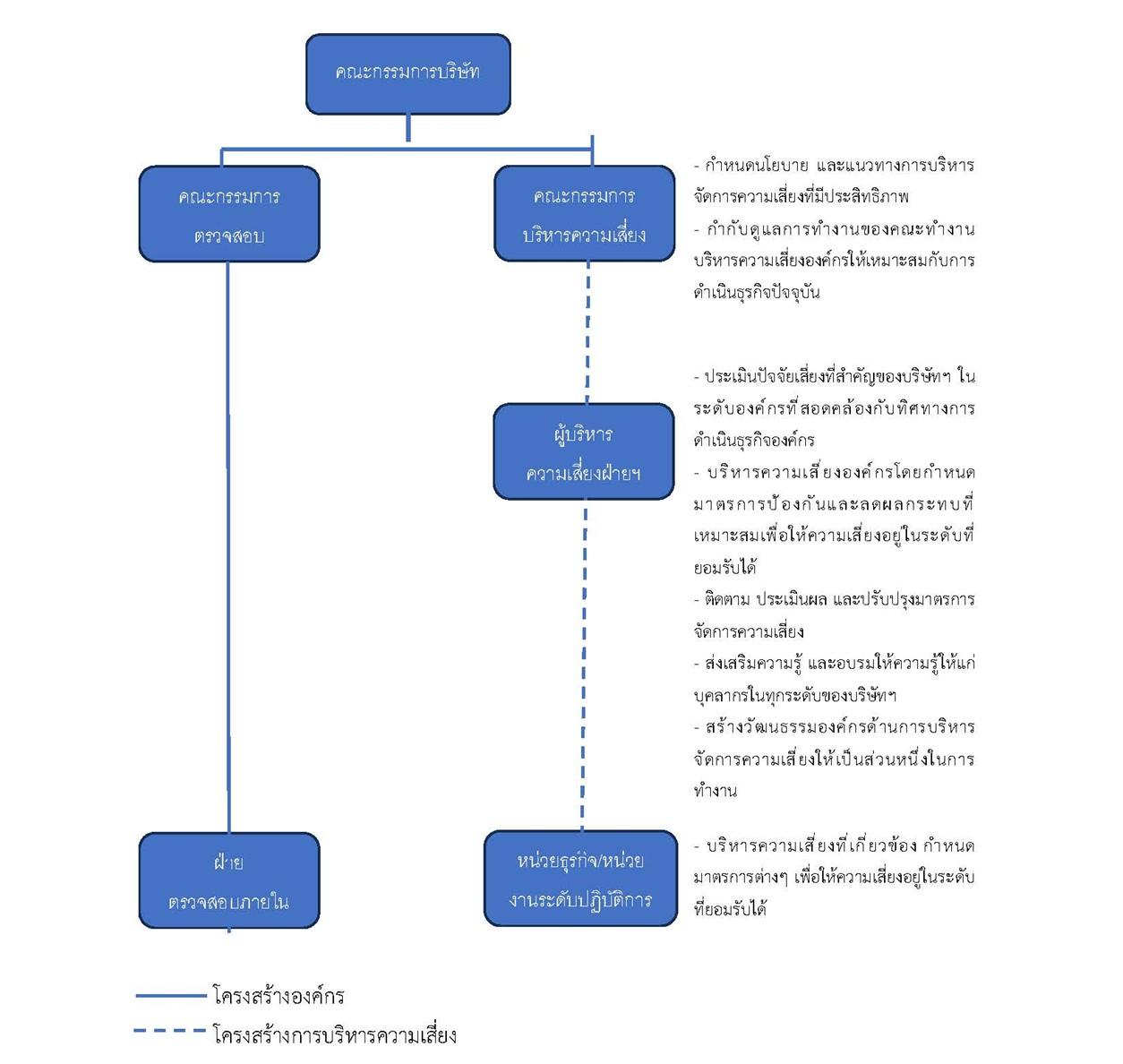
The Company has established the risk management governance structure and assigned responsibilities for organizational risk management as follows:
1. Risk Management Committee (RMC)
The Board of Directors appoints and assigns the Risk Management Committee to establish effective risk management policies and guidelines, and to oversee the operations of the organizational risk management working committee to ensure suitability with current business conditions. The Risk Management Committee comprises a total of 6 members, including the Chief Executive Officer and senior executives, with the Chief Executive Officer serving as the Chairman of the Risk Management Committee and the Managing Director as the Vice Chairman of the Risk Management Committee.
2. Enterprise Risk Management Working Committee
To enable the Company to effectively implement risk management across the entire organization and respond to the Company's risk management policy, the Risk Management Committee has assigned the Enterprise Risk Management Working Committee, comprising 13 top executives from each department, to drive the operations of all units within the Company, promote knowledge, facilitate implementation, and foster an organizational culture where risk management is an integral part of work.
3. Business Units/Operational Level Departments
Manage related risks and establish various measures to keep risks at an acceptable level.
4. Internal Audit Department
The Company assigns the Head of Internal Audit to serve as the Secretary of the Risk Management Committee. The Internal Audit Department will conduct audits and evaluate the effectiveness of the risk management process to ensure that the risk management system is appropriately and efficiently implemented.
Risk Management Policy and Plan
Navanakorn Public Company Limited recognizes and acknowledges the importance of effective risk management as an integral part of good corporate governance, which is a crucial foundation enabling the Company to achieve its objectives, success, and sustainable organizational growth, creating added value and stability for the maximum benefit of the Company's stakeholders, and in accordance with the principles of Good Corporate Governance and Sustainable Development.
Appropriate identification and management of risks will support the Company in making more effective decisions, build confidence in achieving goals amidst changing business environments, and prevent potential losses from various uncertainties. The Company has established the following risk management guidelines:
-
Risk management is designated as the responsibility of employees at all levels, who must be aware of the risks inherent in their own departmental operations and the organization. Emphasis is placed on ensuring that various aspects of risk management are systematically managed under internal controls, maintaining them at an adequate and appropriate level.
-
To establish an organizational risk management process that adheres to good international standards, ensuring efficient management of risks that may impact the Company's operations, fostering development, and promoting consistent risk management practices across the entire organization. This involves integrating the risk management system into decision-making, strategic planning, operational plans, and the Company's operations, as well as focusing on achieving defined objectives, goals, vision, mission, and strategies to create operational excellence and build stakeholder confidence.
-
Guidelines for preventing and mitigating risks from the Company's operations are established to avoid potential damages or losses, including regular monitoring and evaluation of risk management performance.
-
Promote and develop the adoption of modern information technology systems in the Company's risk management process, support access to risk management information for personnel at all levels, and establish an efficient risk management reporting system for the Risk Management Committee and the Board of Directors.
Risk Factors — Overview
Risk Factors — Introduction
The Company recognizes and emphasizes enterprise-wide risk management, as it is a crucial factor for the Company to achieve its business objectives and grow steadily and sustainably.
The Company categorizes risks as follows:
1. Strategic Risk (S) Risks that impact the direction or core mission of the organization, or affect the achievement of organizational objectives, due to political, economic, or external situational changes, or risks arising from erroneous strategic decision-making processes.
2. Operational Risk (O) Risks arising from internal operations within the organization, caused by processes, personnel, or data adequacy, affecting the company's operations, such as a lack of good project management.
3. Financial Report Risk (F) Risks related to the preparation of financial reports, including various reports that influence management's decisions.
4. Compliance Risk (C) Risks arising from the violation or non-compliance with rules, regulations, contracts, and laws related to the company's operations, such as risks from breach of contractual obligations, risks from lack of regulatory reporting, or non-compliance with laws, regulations, and rules.
Risks to the Company's Business Operations
Risk Register
| Risk Name | Risk Characteristics | Consequences | Management Measures | Related Risk Factors |
|---|---|---|---|---|
| Investment Risk | To achieve continuous long-term growth, the Company has invested in expanding its real estate business by acquiring additional land to develop industrial estates and accommodate the needs of customers in the Data Center sector. | Such investments carry risks that could significantly impact revenue and operating costs. Risk factors that may affect the project include volatile economic conditions and government investment policies. The tax adjustment policy of the United States may cause foreign investors to delay investments. | The Company has a strict risk management plan, implemented through investment considerations by the Investment Committee, which comprises qualified individuals with extensive knowledge, expertise, and experience. Investment decisions are made meticulously, expert consultants are engaged, and strong and specialized partners in the relevant business are sought for joint ventures in business development. The Company also employs strategies to adapt to the local areas where investments are made, thereby mitigating the impact of not receiving social acceptance in its business operations. Furthermore, the Company must adapt to survive and remain competitive by transitioning to Digital Transformation, which encompasses work processes, as well as developing personnel skills and organizational culture. This ensures that the Company can adapt and operate according to its defined objectives. | 730 · Description: Government policy · Info category: STRATEGIC_RISK · 731 · Description: Policies or international agreements related to business operations · Info category: STRATEGIC_RISK |
| From the impacts of environmental changes and flooding | Climate change may lead to increased weather volatility and higher than normal precipitation, which could elevate the risk of flooding or severe weather events during certain periods. | Climate change has had an increasingly significant impact, as Pathum Thani province is a low-lying area and serves as a passage for large volumes of water during the rainy season. Although Navanakorn Industrial Estate has implemented a higher standard flood barrier system since 2011, the volatility of global climate conditions may lead to accumulated rainfall exceeding expectations, potentially impacting business operations. | The Company has collaborated with other industrial estates, as well as government agencies, to closely monitor water situations, develop annual risk assessment plans, and secure All Risks Insurance covering flood damage. The Company regularly inspects and maintains its flood barrier system, has established flood prevention and emergency plans, and conducts regular drills. | 1719 · Description: Climate change and disasters · Info category: STRATEGIC_RISK |
| Data Security or Computer Systems and Cyber Attacks | The transition to the digital era and the rapid advancement of technology currently have a significant impact on business operations, work, and the daily lives of individuals in society. Cyberattacks are showing an increasing trend, targeting both network infrastructure and digital data systems. | Rapid technological development may result in damage, loss, or leakage of critical business data, including personal data of employees, customers, and stakeholders. | The Company has closely monitored and tracked its internal operating systems. It has proactive measures to reduce the risk of business data breaches or the leakage of critical information, such as developing systems and equipment to efficiently monitor computer and network security vulnerabilities, and conducting regular annual testing of emergency plans. Furthermore, it raises awareness of cyber threats, prevention methods, and information technology laws. | 744 · Description: Information security and cyber-attack · Info category: OPERATIONAL_RISK |
| Corruption Risk | The Company may face risks of corruption arising from its business operations, interactions with government agencies, business partners, or stakeholders, as well as certain operational processes related to the Company's business activities. | The Company is committed to conducting business with transparency and fairness. It has assessed the risks of corruption that may arise from operations in Navanakorn Industrial Estate. The risk factors that may affect the Company's operations include:
|
| 754 · Description: Corruption · Info category: OPERATIONAL_RISK |
| Liquidity Risk | The Company may face liquidity risk from fluctuations in economic conditions and financial markets, as well as cash flow management in business operations. | The Company prioritizes cash flow management and maintaining an appropriate level of excess liquidity to ensure the continuous operation of its business in Navanakorn Industrial Estate, even amidst volatile economic conditions. Risk factors that may affect liquidity include:
|
| 1724 · Description: Liquidity risk · Info category: FINANCIAL_RISK |